How to File ITR and Claim a TDS Refund for a Deceased Parent: A Legal Heir's Guide
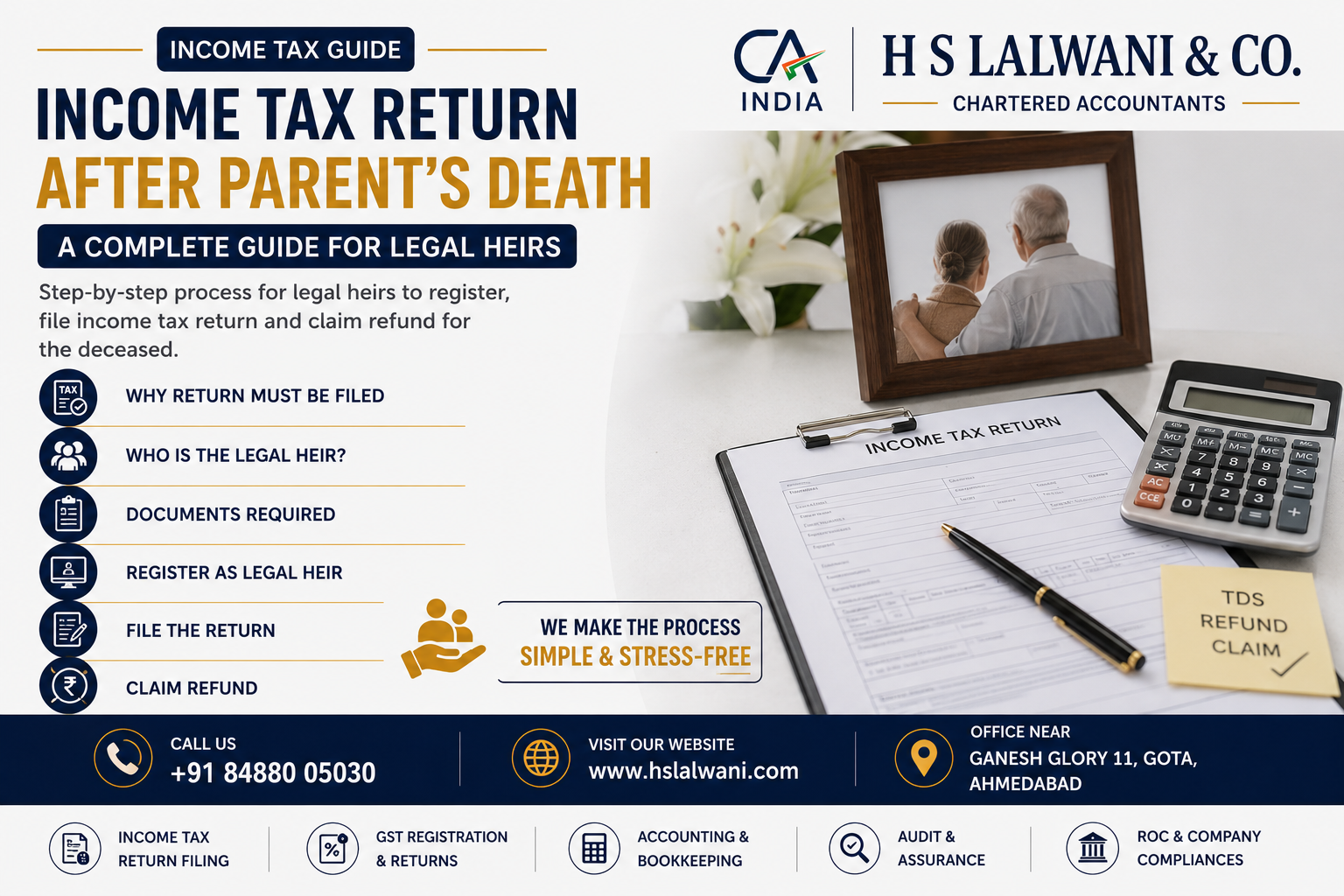
The death of a parent is difficult enough without the added weight of paperwork. Yet one obligation is easy to overlook in the months that follow: the deceased's income tax return. Where tax was deducted at source (TDS) on a parent's pension, bank interest or other income, that money can often be recovered — but only if someone files the return on their behalf.
Under Indian law, that responsibility falls on the legal heir. This guide explains, in plain terms, how a legal heir registers on the income tax portal, files the deceased's return, and claims any refund due.
Why must an income tax return be filed for someone who has died?
It surprises many families, but a person's tax obligations do not end with their death. Under Section 159 of the Income-tax Act, 1961, the legal representative of a deceased person is treated as an assessee and is responsible for filing the return for income earned up to the date of death.
There are two situations where filing matters:
- To claim a refund. If TDS was deducted on the parent's pension, fixed deposit interest or other income, and the total tax deducted exceeds the actual liability, the excess is refundable — but only through a filed return.
- To settle a liability. If the deceased had taxable income above the exemption limit, the return must be filed and any tax due paid, typically from the estate. The legal heir's liability is generally limited to the value of the assets inherited.
In many cases involving elderly parents — a retired pensioner with bank interest, for instance — the return results in a refund rather than a liability, because TDS was deducted through the year but the final tax works out lower.
Who is the legal heir for this purpose?
A legal heir is the person who represents the deceased's estate. For income tax registration, the portal accepts any one of the following as proof:
- Legal heir certificate issued by a court of law
- Legal heir certificate issued by the local revenue authority
- Surviving family member certificate issued by the local revenue authority
- Registered will
- Family pension certificate issued by the State or Central Government
Where more than one heir exists — several siblings, for example — the family should decide who will register and file, as only one legal heir files the return on behalf of the deceased.
Documents you will need
Before starting, keep the following ready in scanned form:
- Death certificate of the deceased
- PAN card of the deceased
- PAN card of the legal heir (self-attested)
- Legal heir proof (any one of the certificates listed above)
- A copy of any order or notice issued in the name of the deceased, if applicable
The legal heir's own PAN must be operative and linked with their Aadhaar, as the refund, if any, is processed with reference to it.
Step 1 — Register as a legal heir on the income tax portal
The legal heir first registers themselves as a representative of the deceased:
- Log in to the income tax e-filing portal (incometax.gov.in) using the legal heir's own credentials.
- Go to the 'Authorised Partners' menu and select 'Register as Representative Assessee'.
- Choose the category of the deceased and enter the deceased's details — PAN, name and date of death.
- Upload the required documents (death certificate, PAN copies, legal heir proof).
- Submit the request.
The request goes to the e-Filing Administrator for review. As per the department, requests are typically processed within about seven days, and the outcome — approval or rejection — is communicated by email and SMS.
Temporary vs Permanent legal heir: If you upload a recognised legal heir certificate, you are approved as a permanent legal heir with full access. If you cannot yet furnish one, you may be approved as a temporary legal heir, permitted only to upload the return, with limited access to other services.
Step 2 — File the deceased's income tax return
Once registration is approved, the legal heir can file the return:
- Log in with the legal heir's credentials and switch the capacity from 'Self' to 'As Legal Heir' for the deceased's PAN.
- Select the correct assessment year.
- Choose the applicable ITR form, based on the deceased's sources of income (pension, interest, house property, capital gains and so on).
- Report the income earned from the start of the financial year up to the date of death. Income arising after the date of death from inherited assets is taxable in the legal heir's own hands, in their own return — not here.
- Claim the TDS credit reflected in the deceased's Form 26AS. Where TDS continued to be deducted after death (common with bank interest), the ITR provides an option in Schedule TDS to transfer that credit appropriately.
- Pay any tax due before filing, then submit and verify the return.
Step 3 — Claiming and receiving the refund
If the return shows a refund — because TDS deducted exceeded the actual liability — it is processed after the return is filed and verified. A few points to note:
- The refund is credited to a bank account validated on the portal in the legal heir's capacity.
- If a refund fails or was determined in an earlier order, the legal heir can raise a 'Refund Reissue Request' under the 'Services' menu after logging in as the legal heir.
- The legal heir's PAN must be operative and Aadhaar-linked for the refund to be released.
Common mistakes to avoid
- Reporting the wrong income. Only income up to the date of death goes in the deceased's return. Income after that date belongs in the heir's own return.
- Missing TDS deducted after death. Banks often continue deducting TDS on the deceased's deposits until informed. This credit should be identified in Form 26AS and handled correctly.
- Multiple heirs filing. Only one legal heir should register and file. Duplicate filings cause confusion and delays.
- Ignoring the return entirely. Where the deceased had taxable income, non-filing can attract notices and penalties for which the legal heir becomes answerable, limited to the inherited estate.
- Not informing the bank. Banks should be told of the death so that TDS deduction and account handling are corrected going forward.
A simple illustration
Consider a retired father who passed away in November. During the year up to his death, he earned pension and bank interest, and the bank had deducted TDS of, say, ₹20,000 on the interest. When his return is filed by his legal heir, the actual tax liability works out to ₹5,000. The remaining ₹15,000 is refundable — recoverable only because the return was filed on his behalf.
How we can help
Filing a return for a deceased parent involves steps that families rarely encounter otherwise — legal heir registration, correct apportionment of income around the date of death, and the treatment of TDS credit. Errors lead to avoidable notices and delays at an already difficult time.
At H S Lalwani & Co., Chartered Accountants, we handle the process end to end — from legal heir registration through to filing the return and following up on the refund. If you need assistance, call +91 84880 05030 or write to cahiteshoffice@gmail.com.
Disclaimer: This article is for general information based on the provisions and income tax portal procedures as they stand at the time of writing. Tax rules and portal processes change, and individual circumstances vary. Please consult a qualified Chartered Accountant for advice specific to your situation before acting.