How to Report Intraday and F&O Income in ITR – A Complete Guide (FY 2025-26)
How to Report Intraday and F&O Income in ITR – A Complete Guide
Every year during the filing season, we meet traders who have made profits in the market but land in trouble simply because they reported their intraday and Futures & Options (F&O) income incorrectly in their Income Tax Return. The rules for these two are genuinely different, and mixing them up is one of the most common reasons for defective return notices and unnecessary scrutiny.
At H S Lalwani & Co., Chartered Accountants, we handle trader tax filings regularly. In this guide, we explain – in plain language – exactly how intraday and F&O income should be reported in your ITR, how losses are treated, how turnover is calculated, and where a tax audit comes in.
Note: This guide is for educational purposes and reflects the position for FY 2025-26 (AY 2026-27). Individual cases can differ, so please consult a Chartered Accountant before filing.
1. The Most Important Point – They Are NOT the Same
Many traders assume intraday and F&O are taxed the same way. They are not. This single distinction changes your ITR form, your loss set-off rights, and your audit position:
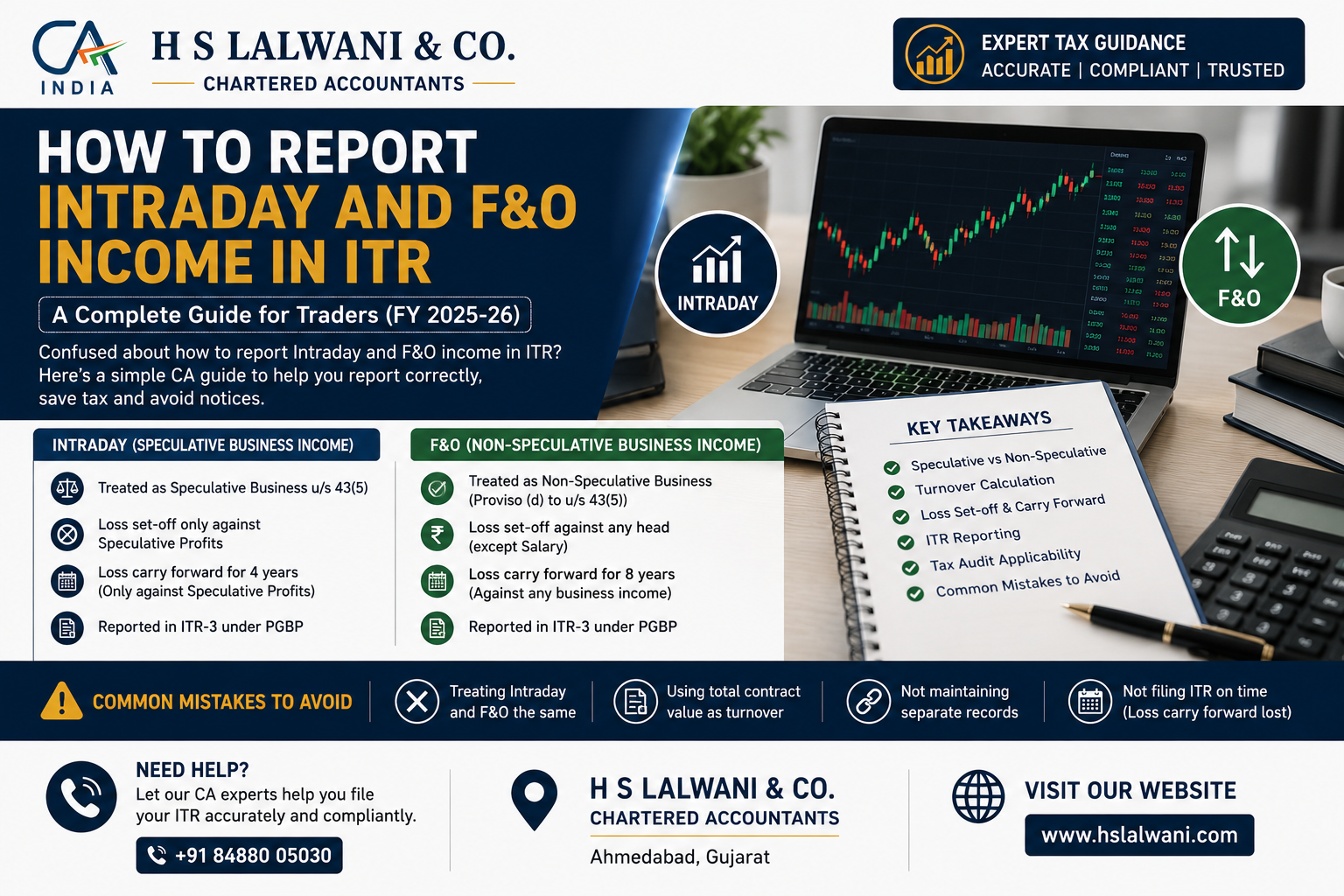
- Intraday equity trading (buying and selling shares the same day without taking delivery) is treated as Speculative Business Income under Section 43(5) of the Income Tax Act.
- F&O trading (futures and options on recognised stock exchanges) is treated as Non-Speculative Business Income. Although F&O is also settled without delivery, proviso (d) to Section 43(5) specifically excludes exchange-traded derivatives from being speculative.
Both are taxed under the head "Profits and Gains from Business or Profession" (PGBP) – not under Capital Gains. And both require you to file ITR-3 (or ITR-4 only if you validly opt for presumptive taxation).
2. How Intraday Income Is Taxed (Speculative)
Because intraday equity trades are speculative, the following rules apply:
- Profits are added to your total income and taxed at your applicable slab rate – there is no special or concessional rate.
- Speculative losses can only be set off against speculative profits – never against salary, house property, capital gains, or even F&O income.
- Unabsorbed speculative losses can be carried forward for 4 assessment years, and only against future speculative gains.
- Carry-forward is allowed only if the ITR is filed on or before the due date under Section 139(1).
3. How F&O Income Is Taxed (Non-Speculative)
F&O is treated as a normal (non-speculative) business, which is actually more favourable for loss adjustment:
- Profits are taxed at your applicable slab rate under PGBP.
- F&O losses can be set off against any head of income except salary in the same year (for example, against interest income, rental income, or other business income).
- Unabsorbed F&O losses can be carried forward for 8 assessment years and set off against any future business income.
- Again, carry-forward requires filing the return within the due date.
This 4-year vs 8-year and speculative vs non-speculative difference is exactly why the two must be reported separately – never clubbed together.
4. How to Calculate Turnover (This Is Where Most Errors Happen)
A very common and costly mistake is treating the total contract value as turnover. That is wrong. For both intraday and F&O, turnover is calculated using the absolute profit and loss method.
Intraday Turnover
Add the absolute value of profit and loss from each trade. For example, a ₹3,000 profit on one trade and a ₹5,000 loss on another gives a turnover of ₹8,000 (3,000 + 5,000), not the total buy/sell value.
F&O Turnover (as per ICAI Guidance Note, Revised 2023)
- The total of favourable and unfavourable differences (absolute profit and loss) is taken as turnover.
- Premium received on the sale of options is included in turnover – however, where that premium is already included while computing the net profit on the transaction, it should not be added again (to avoid double counting).
- Differences on any reverse trades also form part of turnover.
Important update: The earlier practice of separately adding the entire option sell premium has been refined. Following ICAI's revised guidance, double-counting the premium is no longer correct – a point many older articles still get wrong.
5. When Is a Tax Audit Required?
Tax audit under Section 44AB depends on your turnover and profit declaration. In broad terms, for a trading business where transactions are almost entirely digital:
- Turnover up to ₹10 crore: Since virtually all trading is digital (cash receipts and cash payments each stay within 5%), tax audit is generally not required on turnover grounds alone.
- Turnover above ₹10 crore: Tax audit is mandatory, regardless of profit or loss.
- If you opt out of presumptive taxation (Section 44AD) and declare profit below 6% of turnover (or a loss), and your total income exceeds the basic exemption limit, a tax audit can become applicable.
Audit applicability for traders is genuinely fact-specific. It is one area where a quick consultation with a CA can save you from both under-compliance and unnecessary audits.
6. Step-by-Step: Reporting in ITR-3
- Step 1: Use ITR-3 (business income). Do not use ITR-1 or ITR-2 if you have intraday or F&O activity.
- Step 2: Report intraday profit/loss as speculative business income in the relevant part of Schedule BP.
- Step 3: Report F&O profit/loss as non-speculative business income in Schedule BP (kept separate from intraday).
- Step 4: Claim allowable business expenses – brokerage, STT, exchange charges, internet, advisory/software subscriptions, and other costs incurred wholly for trading, under Section 37(1).
- Step 5: Disclose losses correctly so they flow into Schedule CFL for carry-forward (4 years for speculative, 8 years for non-speculative).
- Step 6: Reconcile your figures with the broker's P&L and turnover statement and with your AIS to avoid mismatches.
7. Don't Forget Advance Tax
Since trading is business income, if your total tax liability for the year exceeds ₹10,000, you must pay advance tax in the prescribed instalments. Missing these attracts interest under Sections 234B and 234C.
8. Common Mistakes Traders Make
- Reporting intraday or F&O as capital gains instead of business income.
- Filing ITR-2 instead of ITR-3.
- Clubbing intraday (speculative) and F&O (non-speculative) together.
- Calculating turnover on contract value instead of absolute profit/loss.
- Double-counting option premium in turnover.
- Filing after the due date and losing the right to carry forward losses.
- Ignoring AIS mismatches, which trigger notices.
9. Why Get Professional Help?
Trader taxation looks simple until a notice arrives. The classification of income, correct turnover computation, audit applicability, and timely loss carry-forward all need careful handling. At H S Lalwani & Co., we help traders in Ahmedabad and across India file accurate, notice-proof returns.
- Correct classification of intraday and F&O income
- Accurate turnover and audit assessment
- Proper ITR-3 filing with loss carry-forward
- AIS reconciliation and notice handling
Frequently Asked Questions
Which ITR form is used for intraday and F&O income?
ITR-3, since both are business income. ITR-4 applies only if you validly opt for presumptive taxation.
Can I adjust my F&O loss against my salary?
No. Business losses cannot be set off against salary income. F&O losses can be set off against other heads except salary.
Can intraday loss be set off against F&O profit?
No. Intraday is speculative, so its loss can only be set off against speculative income, not against non-speculative F&O profit.
Is delivery-based short-term equity trading the same as intraday?
No. Delivery-based trades are taxed under Capital Gains, whereas intraday is speculative business income.
Need Help Filing Your Trading Income?
If you trade in intraday or F&O and want your return filed correctly, our team is here to help.
📞 Call +91 84880 05030 or email cahiteshoffice@gmail.com to speak with our tax experts.
Disclaimer: This blog is for general educational and informational purposes only and does not constitute professional tax or legal advice. While every effort has been made to ensure accuracy, tax laws are subject to change and interpretations may vary, so some information may be incomplete or become outdated. H S Lalwani & Co. accepts no liability for any action taken based on this content. Please consult a qualified Chartered Accountant before making any tax-related decision.